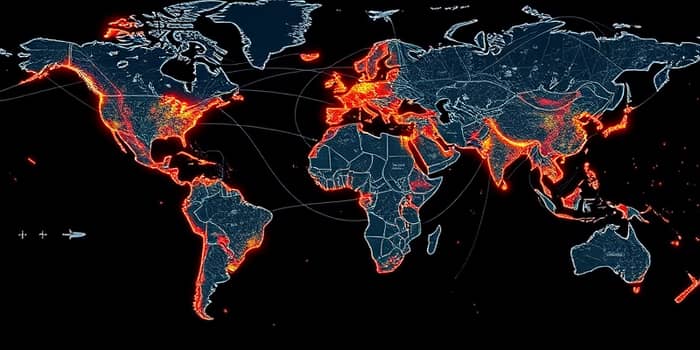
In 2025, businesses and governments find themselves at the crossroads of transformation. Global commerce is expanding, yet structural shifts and geopolitical currents demand new strategies.
This article offers an authoritative overview of trade trends and practical guidance to thrive amid uncertainty.
Global economic growth is forecast at 3.0% for 2025 and 3.1% for 2026, reflecting renewed fiscal expansion in major economies and front-loading ahead of tariffs. Total exports reached nearly $25 trillion in 2024, and trade in goods is expected to climb by 2.7% in 2025.
Despite policy volatility and persistent tensions, trade volumes rose by roughly $500 billion in the first half of 2025, on track for record highs. Improved financial conditions and lower tariff rates have underpinned this resurgence, even as stakeholders wrestle with new barriers.
Trade dynamics vary significantly across regions, reflecting local policies, currency movements, and supply chain shifts. Below are key developments:
Additional highlights include Canada’s Q2 export contraction due to lower oil prices, UK trade gains led by pharmaceuticals and autos, and Australia’s mixed growth in ores and manufactured goods.
Certain industries are redefining global supply chains. Semiconductors and high-tech goods anchor Asia-centric supply chains, with Taiwan, South Korea, and China leading chip exports. Electric vehicles also reshape trade flows: Germany exports $29.1 billion worth, and China $25.4 billion, through September 2024.
Pharmaceuticals show remarkable strength: Ireland supplied $42.8 billion to the U.S. in the first ten months of 2024, while digital services—travel, ICT, and financial services—outpace goods in many markets, reflecting rising digital trade integration.
Trade barriers and shifting alliances shape the landscape. Tariff announcements in the U.S. and protectionist proposals in some markets heighten uncertainty, though the sheer scale of commerce makes a reversal of globalization unlikely.
Currency fluctuations—particularly a modest depreciation of the U.S. dollar—contributed to Q2 2025 trade data. In response to import slowdowns, China has signaled more accommodating monetary policy through 2025.
Companies and governments are pivoting to manage risk and seize opportunities. Key adaptation strategies include:
Looking ahead, the pace of trade growth will likely remain below historical averages, constrained by geopolitical tensions and currency volatility. Yet, the rise of digital commerce and green supply chain initiatives offers new avenues for expansion.
Logistics and infrastructure investments—together a $10 trillion sector—will determine who wins in the evolving marketplace. Companies that embrace innovation, foster resilience, and anticipate policy shifts will navigate these shifting sands with confidence, positioning themselves at the vanguard of the next era of global trade.
References