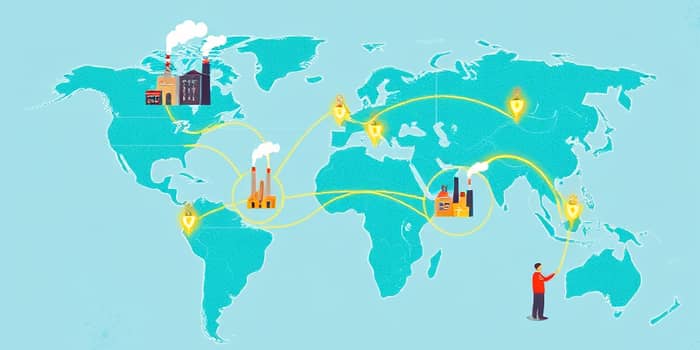
Global manufacturing is undergoing a profound transformation. Companies are abandoning decades of reliance on distant, single-source factories in favor of regional supply networks with greater resilience. Two strategies dominate this evolution: nearshoring and friendshoring.
For years, offshoring to low-cost countries drove unprecedented efficiency and scale. Yet the COVID-19 pandemic exposed massive supply chain disruptions, from empty ports to factory shutdowns. Simultaneously, geopolitical tensions and trade wars underscored the risks of overspecialization in a few distant hubs.
In response, businesses have started to re-evaluate their footprint. Rather than bring everything back home, many opt to shift production to geographically closer production partners or politically stable allies. This hybrid approach balances cost, risk, and speed.
Nearshoring refers to relocating manufacturing or sourcing to countries that are geographically closer to a company’s primary markets. Examples include U.S. firms moving assembly lines to Mexico or European players shifting output to Eastern Europe.
Friendshoring goes beyond geography. It emphasizes partnerships with politically allied, stable countries that share values and reduce geopolitical exposure. A U.S. electronics maker moving some operations from China to Vietnam or India typifies this approach.
For contrast, reshoring—bringing production back to the home country—remains important but is not the central theme here. Nearshoring and friendshoring often coexist within hybrid logistics ecosystems for flexibility.
Several powerful forces are driving companies toward these strategies:
Companies embracing these strategies gain numerous advantages:
Collectively, these benefits foster robust regional manufacturing ecosystems, stimulating local economies and deepening trade ties.
Recent figures underscore the momentum behind regionalization and allied sourcing:
Leading companies now blend both approaches, creating adaptive, hybrid supply networks. This model uses regional hubs for standard products while relying on trusted allies for critical components.
Shifting supply chains is not without obstacles. Firms face:
To navigate these issues, companies must perform holistic site selection and risk assessments, weighing ESG factors, labor markets, infrastructure, and long-term stability alongside traditional cost metrics.
Nearshoring and friendshoring are more than temporary responses—they represent a structural shift in global trade. Expect continued investments in regional manufacturing hubs across North America, Eastern Europe, and Southeast Asia. Governments will likely enact policies to support this trend:
Technology will play a pivotal role. Automation, AI-driven supply chain analytics, and digital twins will enhance responsiveness and efficiency in nearshored and friendshored operations.
The interplay of risk, cost, and sustainability has ushered in an age of regional collaboration and allied partnerships. Nearshoring and friendshoring allow businesses to build supply chains that are not only efficient but also resilient and aligned with core values.
By thoughtfully integrating these strategies, companies can safeguard against future disruptions, foster closer customer relationships, and contribute to economic development within trusted networks. As we look ahead, regional and allied sourcing will become standard practice, shaping a more balanced and secure global manufacturing landscape.
References