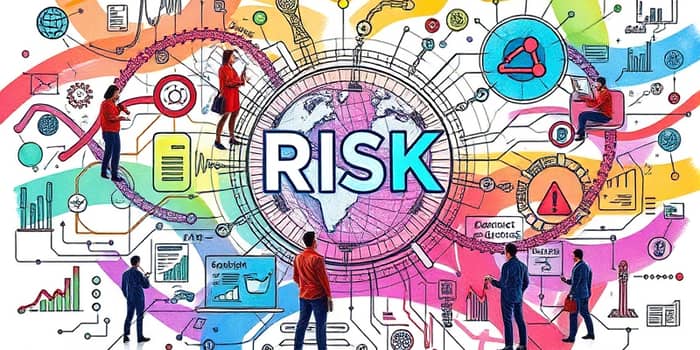
In a world defined by volatility and rapid change, risk management can no longer be an afterthought. Organizations must evolve to meet threats that span from digital vulnerabilities to geopolitical upheaval. This article explores how leaders can harness cutting-edge frameworks and technologies to build robust, adaptive defenses.
Drawing on the latest trends, expert insights, and real-world examples, we offer actionable strategies to transform risk management from a static compliance exercise into a dynamic competitive advantage. Read on to discover how to reshape your approach and thrive amid uncertainty.
The modern risk profile extends far beyond natural disasters or financial shortfalls. Today’s leaders face a tapestry of challenges, including strategic planning, financial modeling, cyber threats and compliance demands. These factors converge to create an environment where agility and foresight determine success.
Moreover, the rise of distributed workforces and global supply chains has amplified operational complexity. Organizations must consider not only their direct exposures but also the vulnerabilities of partners and vendors. In this context, embracing uncertainty is no longer optional; it is integral to strategy and leadership.
Several frameworks have emerged as benchmarks for effective risk management. While each offers unique strengths, many organizations now adopt a hybrid approach, customizing principles to fit their culture and goals.
Customization is key. Leading enterprises blend elements from multiple frameworks to create tailored, cross-functional risk programs that align with their strategic objectives and regulatory landscape.
Artificial intelligence and machine learning are transforming how risks are identified and mitigated. Real-time analysis of large datasets allows organizations to detect anomalies before they escalate into crises. Predictive models forecast potential impacts, enabling proactive decision-making.
Use cases include fraud detection, automated vulnerability scanning, and market trend forecasting. By leveraging real-time data analysis and anomaly detection, teams can prioritize risks based on quantitative evidence rather than intuition alone.
Across industries, organizations are pioneering new methods to enhance resilience:
These examples illustrate the power of integrating advanced tools with strong governance and a risk-aware culture.
Building an effective risk program demands more than tools; it requires organizational alignment. Boards, IT, compliance, and operations must collaborate seamlessly to share insights and respond swiftly.
Key steps include:
Scenario planning enables organizations to anticipate “what-if” situations and craft actionable playbooks. By engaging diverse stakeholders, teams identify early warning indicators and define triggers for escalation.
Diversification across vendors, geographies, and product lines further spreads exposure and prevents single points of failure. When combined with robust scenario frameworks, this approach bolsters resilience against both expected disruptions and low-probability “black swan” events.
Traditional risk heatmaps offer qualitative insights but can fall short in dynamic environments. Moving to quantitative models such as Monte Carlo simulations and loss expectancy calculations provides a clearer picture of potential costs and probabilities.
Data-driven scoring systems help prioritize remediation efforts and communicate risk levels to executives. Integrating machine-learning forecasts refines these models over time, leveraging new information to improve accuracy.
Governance, Risk, and Compliance (GRC) platforms unify policy management, incident tracking, and reporting. By automating workflows and centralizing data, these tools eliminate silos and accelerate response times.
Real-time dashboards combine Key Risk Indicators (KRIs), risk appetite metrics, and action plans, ensuring that decision-makers have an up-to-the-minute view of the organization’s risk posture.
As we look beyond 2025, several trends will shape the future of risk management:
Organizations that invest in these capabilities and cultivate a culture of continuous resilience improvement will outpace peers, turning uncertainty into an opportunity for innovation and growth.
References