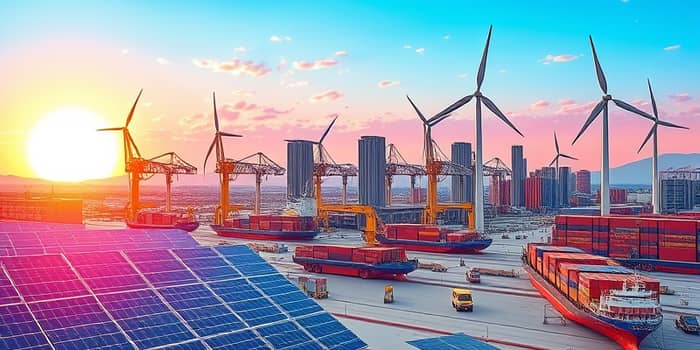
In the face of climate urgency and evolving markets, the global energy landscape is undergoing a seismic shift in energy production. Industries, governments, and communities worldwide are embracing change with unprecedented speed, driven by both environmental imperative and economic opportunity. This article explores how the energy transition is fundamentally altering the way we produce, consume, and value power across every sector.
The historic reliance on fossil fuels, which supplied nearly 80% of global primary energy for decades, is giving way to a more balanced mix. Projections indicate that by 2050 the energy portfolio will be split evenly: 50% fossil and 50% non-fossil sources. Beyond that, non-fossil energy will dominate electricity generation, reducing the fossil share from 59% today to just 4% by 2060.
Renewables are at the core of this transformation. In 2023 alone, the world added 562 GW of renewable capacity—more than 60% above 2022 levels. As solar and wind expand, global electricity demand is set to rise 120% by 2060, climbing from 21% to 43% of total energy consumption. This surge in power will also fuel hydrogen production for sectors that resist direct electrification.
Several factors are accelerating the transition, while significant obstacles remain. Understanding these forces is essential for stakeholders seeking to navigate the evolving energy ecosystem.
Growth rates and policy environments vary widely across regions, shaping distinct pathways for each market.
China’s leadership in solar PV is unmatched, accounting for 47% of global capacity by the end of 2025. While coal use remains high for energy security, renewables are steadily displacing fossil generation. Emissions in Greater China are expected to peak between 2030 and 2040 before declining.
Europe holds 20% of global solar PV capacity and pursues aggressive renewable build-out, though current efforts still fall short of 2030 targets. Liquefied natural gas demand is diminishing, reflecting the bloc’s commitment to decarbonization while balancing industrial competitiveness.
In the United States, recent policy reversals have delayed emissions reductions by five years, even as AI-driven data centers emerge as major electricity consumers. Meanwhile, the rest of the world is installing renewables at roughly 25% annual growth, often guided by cost-effective Chinese clean technologies. Regions such as India, Southeast Asia, and the Middle East will peak emissions by mid-century, whereas Sub-Saharan Africa’s emissions rise through 2060 as it accelerates development.
The transition’s impact differs by sector, with some facing rapid change and others confronting stubborn hurdles.
Power sector emissions are projected to fall by 88% by 2050. Coal is set for a steep decline—between 35% and 94%—while renewables will provide over half of electricity generation under all scenarios. Natural gas may hold steady or grow in select markets.
Transport emissions could drop 58% by mid-century as electric vehicle charging infrastructure expands, particularly in Europe and China. However, heavy industry and aviation remain challenging to decarbonize; hydrogen is poised to cover just 6% of industrial demand by 2060.
Buildings will see increasing electrification of heating and cooling, supplemented by behind-the-meter solar and battery systems, which could supply 13% of power by 2060, empowering consumers with greater resilience and autonomy.
Technological innovation is the engine of progress, driving down costs and opening new pathways.
Solar PV capacity is expected to exceed 3,000 GW by the end of 2025, making rooftop and distributed systems ever more attractive. Wind installations continue their upward trajectory, led by offshore developments in Europe and Asia.
Green hydrogen, though only 3.5% of the energy mix by 2050, will play a critical role in indirect electrification of heavy industry and shipping. Carbon capture and storage is slated to remove an estimated 35 Gt of CO₂ between 2025 and 2060, accounting for 4% of cumulative emissions reductions.
Meanwhile, AI and digitalization escalate electricity demand in North America, underscoring the need for smart, flexible grids and storage solutions.
Despite GDP expected to nearly double by 2050, average annual global energy expenditure will stabilize around USD 6.5 trillion. Renewables’ low operating costs mean energy becomes a smaller share of economic output and household budgets.
Traditional fossil fuel industries face contraction, while sectors such as renewables manufacturing, battery storage, and electrification services thrive. Energy security concerns are reshaping supply chains, prompting reshoring and localized production of critical components.
Global CO₂ emissions are on track to decline 43% by 2050 and 63% by 2060, yet net zero may not arrive until after 2090. Without accelerated action, the world is still headed toward 2.2°C of warming by 2100, with the 1.5°C carbon budget exhausted by 2029.
Energy security is driving domestic renewables in importing countries while boosting fossil exports in major producers. Trade disputes, such as US tariffs on solar imports, influence costs and deployment timelines.
Policy shifts vary: US reversals have slowed progress, Europe continues to juggle climate goals with industrial competitiveness, and China leads in deployment and clean tech exports, accelerating global adoption.
By 2060, the energy system will be transformed but still incomplete. Fossil fuels will persist in hard-to-decarbonize sectors, and the pace of change must quicken to meet Paris Agreement targets. Meeting COP28’s call to triple renewables by 2030—reaching 11,000 GW—requires installing over 950 GW annually.
The energy transition presents an extraordinary opportunity: to decarbonize our planet, spur industrial innovation and job creation, and secure a sustainable future for all. Governments, corporations, and individuals must act in concert—accelerating investment, embracing new technologies, and advocating for resilient policy frameworks. Together, we can reshape global industries and chart a course toward a cleaner, more equitable world.
References