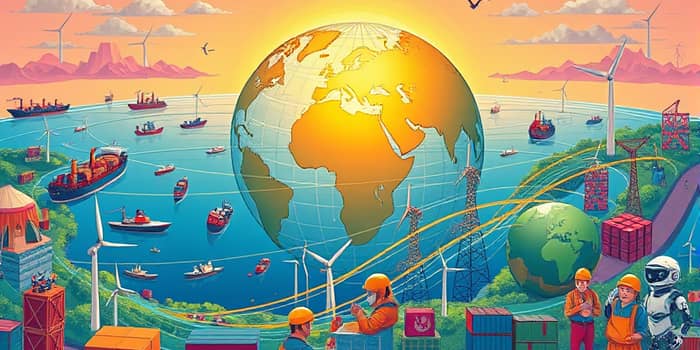
Globalization has been a driving force behind prosperity, innovation, and cross-border collaboration for decades. Yet as we stand at a critical juncture, economic slowdowns, geopolitical tensions, and climate imperatives are prompting a profound reappraisal of what it means to be interconnected.
In this comprehensive analysis, we delve into the key trends, challenges, and opportunities shaping the next phase of globalization. From the shifting balance of power between major economies to the transformative impact of artificial intelligence and the urgent need for sustainable development, we explore the forces that will define our shared future.
By 2023, global trade in goods and services reached an unprecedented $32 trillion, reflecting deepening global economic integration that lifted millions out of poverty and fueled innovation across industries. Yet growth is expected to decelerate from 3.3% in 2024 to just 2.9% by 2026, according to IMF and OECD forecasts.
The resurgence of protectionism has raised the US average tariff rate to 18.2% in 2025, the highest since 1934, rerouting supply chains and inflating costs. Estimates place the financial impact of system fragmentation between $0.6 and $5.7 trillion, underscoring the high stakes of fractured cooperation.
Amid these challenges, businesses are diversifying and nearshoring operations, forming regional partnerships to buffer against shocks. Policymakers must strike a balance: reducing barriers to trade while safeguarding national interests, ensuring both security and growth.
We are witnessing multipolar global power diffusion as emerging economies like China, India, and Brazil challenge Western dominance. Projections indicate the BRICs may rival the G-7’s GDP share by mid-century, reshaping alliances and negotiating blocs.
The US-China rivalry has spawned a bifurcated global technology sphere, with separate standards, supply chains, and digital ecosystems. While Western nations strengthen security alliances, China expands its footprint in Europe and Latin America, boosting exports to Europe by 6% and to Mexico and Canada by 25% in 2025.
Resource competition for lithium, rare earths, and other critical minerals is intensifying. Governments must collaborate on ethical sourcing and recycling to avoid a new era of resource nationalism reminiscent of colonial models.
Artificial intelligence stands at the heart of globalization’s next wave. By 2038, responsible AI adoption could generate $1.2 trillion in consumer industries, while automation may create 170 million new roles even as it displaces 92 million jobs by 2030.
Tech giants like Nvidia and Microsoft, each surpassing $4 trillion in market capitalization, illustrate the stakes. Yet AI’s benefits are uneven: 57% of US jobs disrupted by generative AI are held by women, highlighting persistent gender disparities in tech.
Data localization and regulations, from GDPR to India’s Data Protection Act, are carving the internet into regional spheres. Businesses face compliance costs but gain consumer trust through transparent data practices. Cross-border e-commerce is projected to hit $7.9 trillion by 2030, driven by seamless digital payments and logistics.
As climate concerns intensify, corporations and governments embrace accelerated climate action and sustainable growth. Renewables now cost 41% less than solar and 53% less than wind on average, while accounting for 92.5% of new electricity capacity in 2024.
Yet the surge in data centers and extreme weather events threatens progress. Rising energy demands from digital infrastructure must be balanced with investments in storage technology, grid resilience, and energy efficiency.
Resource pressure on food, water, and raw materials intensifies with population and economic expansion. Collaborative frameworks for water sharing and sustainable agriculture will be essential to avoid conflicts and ensure equitable development.
The global workforce is undergoing seismic shifts. Continuous workforce learning as the new normal is imperative as AI and green technologies reshape job requirements. Reskilling initiatives must be publicly and privately funded to prepare workers for emerging roles.
Women remain underrepresented in STEM and leadership positions, risking exclusion from the future economy. Targeted mentorship, scholarships, and inclusive hiring practices can narrow the gender gap and enrich innovation.
The rise of remote and “glocal” teams blends global talent with local expertise, fostering cultural fluency and operational resilience. Organizations that cultivate hybrid models will attract diverse skill sets and improve retention.
Brands and institutions are pursuing hyper-localization, adapting products, content, and marketing to regional tastes. This nuanced approach rebuilds trust and relevance in a fragmented world.
Simultaneously, misinformation—often amplified by AI algorithms—fuels societal polarization. Collaborative media literacy programs and transparent content moderation are vital to bolster social cohesion.
Calls for inclusive growth emphasize gender parity, disability access, and equitable representation in tech and green sectors. Embracing diversity is not just ethical—it enhances problem-solving and market reach.
The post–World War II multilateral architecture is under strain. While fragmentation increases, global challenges—climate change, pandemics, digital regulation—demand coordinated responses. Reforming institutions like the UN, WTO, and multinational development banks can restore effectiveness.
Digital fragmentation between the US, EU, and China complicates setting universal norms. A pragmatic path forward includes interoperable standards, mutual recognition agreements, and inclusive rule-making platforms.
The future of globalization hinges on our collective ability to adapt institutions, share technology responsibly, and invest in people. By embracing sustainable business models and multilateral cooperation, we can forge a resilient, inclusive global order.
Policymakers, corporations, and civil society must collaborate on forward-looking frameworks for trade, digital governance, and climate action. Only through coordinated efforts can we ensure that interconnectedness remains a source of shared prosperity, innovation, and human dignity.
As we re-evaluate our global ties, the pressing question is not whether we can sustain globalization, but how we can reshape it to serve people and the planet in the decades ahead.
References