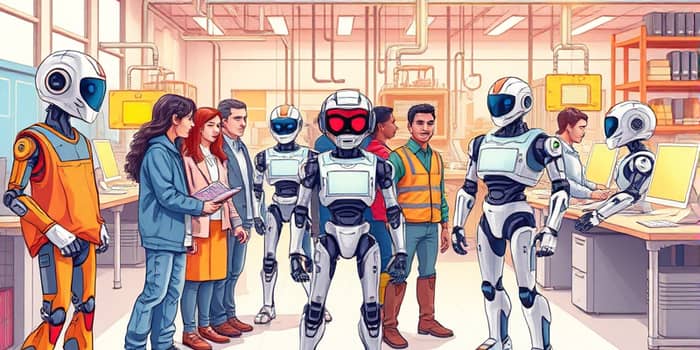
As artificial intelligence and robotics advance at breakneck speed, they bring profound changes to economies and societies worldwide. From factory floors to office desks, rapidly transforming global labor markets is now an everyday reality that demands strategic responses.
This in-depth article explores trends, forecasts, and actionable strategies to help individuals, businesses, and policymakers navigate this pivotal shift.
The story of automation traces back centuries, from early textile machinery to the digital revolution of the late 20th century. Today’s leap is powered by cloud computing, big data analytics, and breakthroughs in generative AI—technologies that enable machines to learn, adapt, and even create.
Multiple studies forecast that by 2030, up to 300 million jobs, about 9.1% of the global workforce, could be displaced by AI and robotics. Depending on adoption scenarios, between 400 million and 800 million workers may need to reskill or switch careers. Yet, an optimistic view predicts 78 to 97 million new jobs emerging in AI ethics, prompt engineering, machine collaboration roles, and other fields.
By 2025, the net gain of 12 million jobs underscores the complex interplay between displacement and opportunity. Experts debate whether this net positive will materialize uniformly or concentrate in certain regions and sectors.
Industries across the board experience divergent effects as automation penetrates routine and cognitive tasks. Grasping these dynamics enables targeted preparation and investment.
While automation reduces repetitive workloads, it also unlocks new AI-driven career opportunities in data annotation, algorithm auditing, and human-AI collaboration management—positions requiring interdisciplinary skills.
Beyond these clear-cut cases, emerging fields such as telemedicine, personalized education, and AI-assisted design highlight automation’s potential to generate entirely new markets.
Automation’s reach is uneven. North America, leading in AI investment, may see up to 70% of tasks automated by 2025, while East Asia’s robust manufacturing base created two million skilled roles from 2018 to 2022 despite heavy robot adoption. In contrast, many developing economies face risks of offshored services and limited infrastructure to retrain displaced workers.
Gender and socioeconomic factors further shape outcomes. In the United States, roughly 59 million women and 49 million men hold positions highly exposed to AI, indicating a disproportionate impact on female workers. Additionally, 13.7% of U.S. employees report job losses due to automation, and nearly half face significant risk within the next decade.
These disparities amplify the need for inclusive policies ensuring equitable access to training, digital infrastructure, and economic support programs.
Automation drives remarkable productivity gains but can widen inequality if left unaddressed. Generative AI tools have the potential to boost labor productivity by approximately 15% in mature economies, while AI-driven customer support saves businesses an estimated $8 billion annually.
left unchecked, these dynamics risk creating a two-tiered workforce: a skilled minority commanding high wages and a displaced majority struggling to adapt.
Proactive, collaborative approaches are critical to mitigate displacement and harness automation for shared prosperity. Governments, businesses, and educators must unite around comprehensive workforce development programs that include:
Countries like Singapore, with its SkillsFuture initiative, and Germany, through its dual vocational training system, exemplify how structured programs can ease transitions and maintain low unemployment.
To thrive amid rapid change, both individuals and organizations must embrace a growth mindset. Key actions include:
By adopting these measures, stakeholders can build resilient workforces capable of leveraging technology rather than being sidelined by it.
The march of automation is inexorable, but its outcomes remain in our hands. We can choose a path of concerted action—where displaced workers are retrained, where emerging sectors thrive, and where technological advances lift all segments of society.
The data may highlight daunting figures—hundreds of millions of jobs at risk by 2030—but they also reveal a landscape rich with new AI-driven career opportunities, higher productivity, and the promise of more meaningful work.
Success requires collaboration: visionary policies, corporate responsibility in upskilling, and personal commitment to adaptability. If we embrace this journey together, the automation revolution can usher in an era of inclusive growth, innovation, and shared prosperity.
Let us marshal our collective creativity and resilience to shape a future where technology augments human potential and paves the way for a more equitable world.
References