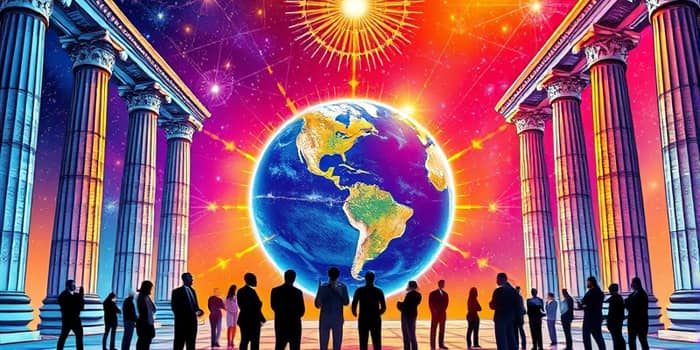
In an era defined by interconnected markets and shared challenges, the framework of global economic governance emerges as a pivotal force shaping our collective future. From preventing financial crises to advancing sustainable development, international institutions stand as beacons of cooperation in a complex world.
As readers and participants in the global economy, understanding these institutions empowers us to engage more effectively, advocate for accountability, and champion inclusive growth. This article charts the origins, functions, achievements, and ongoing challenges of the key players guiding economic governance today.
At its core, economic governance denotes the rules, norms, and processes that guide financial interactions beyond national borders. It is not a centralized authority but a network of institutions, states, NGOs, and corporations collaborating to manage cross-border trade, finance, and development.
The primary objectives are clear: promote macroeconomic stability, facilitate trade and investment, address transnational issues like climate change or pandemics, and foster sustainable development goals. By harmonizing policies and resources, these actors strive to prevent crises and support equitable growth.
Several cornerstone organizations anchor the system of global economic governance. Each brings unique mandates and tools to the table, ensuring a balance of oversight, finance, and norm-setting.
Beyond these formal bodies, emerging actors—regional banks, rating agencies, and civil society groups—play an increasing role in shaping norms and pushing for transparency.
Each function reinforces the others: effective rule-setting enhances stability, while financial assistance underpins development projects and crisis recovery.
The origins of modern economic governance trace back to the 1944 Bretton Woods Conference, which birthed the IMF and World Bank. Five decades later, the World Trade Organization was established to enforce multilateral trade rules.
Over the years, these institutions have been instrumental in addressing global challenges. During the Asian financial crisis of 1997 and the 2008 global meltdown, the IMF’s emergency funding and policy guidance helped stabilize economies. The World Bank reports that over a billion people have escaped extreme poverty since 1990, owing in part to sustained development investments.
Trade liberalization under the WTO framework has increased global merchandise trade nearly sixfold since 1980, illustrating the power of shared rules. Initiatives like the Extractive Industries Transparency Initiative showcase how norm-setting fosters trust and accountability.
Despite these successes, valid criticisms persist. A democratic deficit plagues many institutions: developed economies wield disproportionate influence, leaving emerging and low-income countries under-represented in decision-making forums.
Implementation gaps also frustrate progress. Agreements on paper often lack enforcement, and fragmented mandates can lead to duplication of efforts. Critics highlight a systemic bias favoring wealthy states and multinational corporations, perpetuating inequalities.
Moreover, the rapid pace of globalization, the digital economy, and climate change demand agile governance structures. Traditional institutions struggle to adapt, prompting calls for innovation in policy coordination and accountability mechanisms.
Reform efforts are underway across the board. The United Nations promotes greater coherence among its economic, environmental, and social pillars, while calls grow louder to increase the voice of developing nations in quota and voting systems.
The IMF and World Bank have embarked on internal reforms to adjust quotas, expand assistance channels, and strengthen anti-corruption safeguards. Regional development banks like the Asian Infrastructure Investment Bank and initiatives like BRICS’ New Development Bank enrich the governance landscape by offering alternative financing options.
For individuals and organizations seeking practical engagement, consider the following steps:
No single entity can manage the world economy alone. Progress depends on the synergy between governments, international institutions, the private sector, and civil society.
By embracing reform, advocating for equity, and leveraging new platforms for cooperation, we can build a more resilient, inclusive, and sustainable system. Each voice matters: whether as a policymaker, business leader, researcher, or concerned citizen, your participation drives positive change.
Together, we can ensure that international institutions remain adaptive guardians of economic stability and champions of a fair global order—transforming shared challenges into opportunities for all.
References