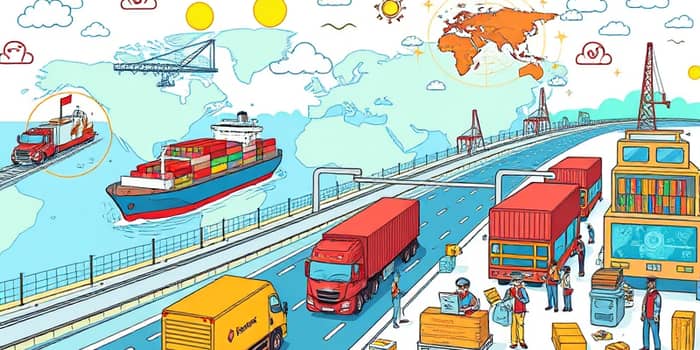
In today’s fast-changing market landscape, organizations face an unprecedented confluence of economic, environmental, and geopolitical challenges. From persistent inflation to extreme weather events, each disruption tests the strength of global supply chains. Developing robust strategies to adapt and thrive is no longer optional—it is essential for survival.
Supply chain resilience goes beyond traditional recovery models. It demands the capacity to anticipate, adapt, persist, and transform in the face of shocks. By weaving together visibility, flexibility, collaboration, and advanced analytics, companies can turn volatility into opportunity.
At its core, supply chain resilience is the ability of a network to withstand disruptions and minimize their impact on revenues, costs, and customer satisfaction. This concept comprises more than bouncing back; it emphasizes forward-looking adaptation and transformation.
Four pillars support resilience:
Persistent inflation has altered cost structures and consumer behaviors. Even as headline rates moderate, rising input prices force companies to rethink margin management. According to industry surveys, 60% of firms focus on optimizing inventory and supply, while 43% prioritize data-driven decision-making.
Meanwhile, volatile consumer demand—cited by 52% of retailers as their top challenge—drives a 14% year-over-year surge in strategic inventory buffers. Companies balance lean operations with safety stocks for critical components, ensuring service levels without excessive cost drag.
Geopolitical turbulence, rising tariffs, and protectionist policies threaten 20–30% of manufacturers’ EBIT margins. Yet substantial investments—such as $35 billion in US EV production from 2021 to 2024—signal a strategic pivot toward reshoring and regional nearshoring.
In 2024, 80% of organizations experienced at least one major supply chain disruption, many facing multiple simultaneous events. Natural disasters, cyber-attacks, port congestion, and labor shortages top the list of causes.
Accurate measurement of risk exposure enables proactive responses. The following table highlights critical disruption metrics:
Building resilience requires a holistic approach. Consider these proven practices:
Collaboration amplifies these efforts. Sharing forecasts and risk assessments with logistics partners, suppliers, and customers fosters joint response plans and quick decision-making under stress.
Cost-Resilience Balance is critical: avoid "resilience at all costs" by identifying high-impact nodes where investment yields the greatest stability without undermining competitiveness.
Industry exposure varies widely. Consumer electronics and semiconductors—concentrated in climate-sensitive regions—face acute risk from extreme weather and geopolitical shifts. In contrast, medtech manufacturing, with its geographically dispersed facilities, enjoys greater environmental and political insulation.
The automotive sector, especially EV production, highlights how policy incentives and tariff pressures drive reshoring. Strategic partnerships with local suppliers can mitigate cost swings and ensure smoother production ramp-ups.
Case: CSAT Solutions streamlined its vendor base, deepened collaboration with key partners, and implemented advanced analytics to forecast demand. As a result, the company achieved a 20% reduction in stockouts and a 15% improvement in order fulfillment times—demonstrating the power of CSAT Solutions' success story in practical resilience application.
Regulatory bodies and governments play pivotal roles by setting standards, providing incentives, and facilitating public-private partnerships. The OECD’s "bounce forward" framework emphasizes not just recovery, but also integrating lessons to lower future risks and driving systemic improvement.
Looking ahead, digital supply chains powered by AI and big data will become the norm. Companies that invest in robust scenario planning, stress-testing, and sustainable practices will create competitive advantages and safeguard operations against evolving threats.
In a volatile world, supply chain resilience is both a strategic imperative and a competitive differentiator. By embracing comprehensive frameworks—prioritizing visibility, agility, collaboration, and technology—organizations can transform disruptions into catalysts for innovation. Ultimately, resilience is not just about surviving shocks; it is about thriving in their wake, forging stronger, more adaptable supply networks for the future.
References